Heavy Duty Truck Repair Is Moving to a New Location
Heavy Duty Truck Repair is currently going through an exciting period of reorganization and relocation to a new facility. As we prepare for this…
 Tomas Labinskis
Aug 24, 2026
Heavy Duty Truck Repair is Temporarily Closed While We Get Settled Into Our New Space. Read more

Homer Glen, IL
Tomas Labinskis
May 29, 2026
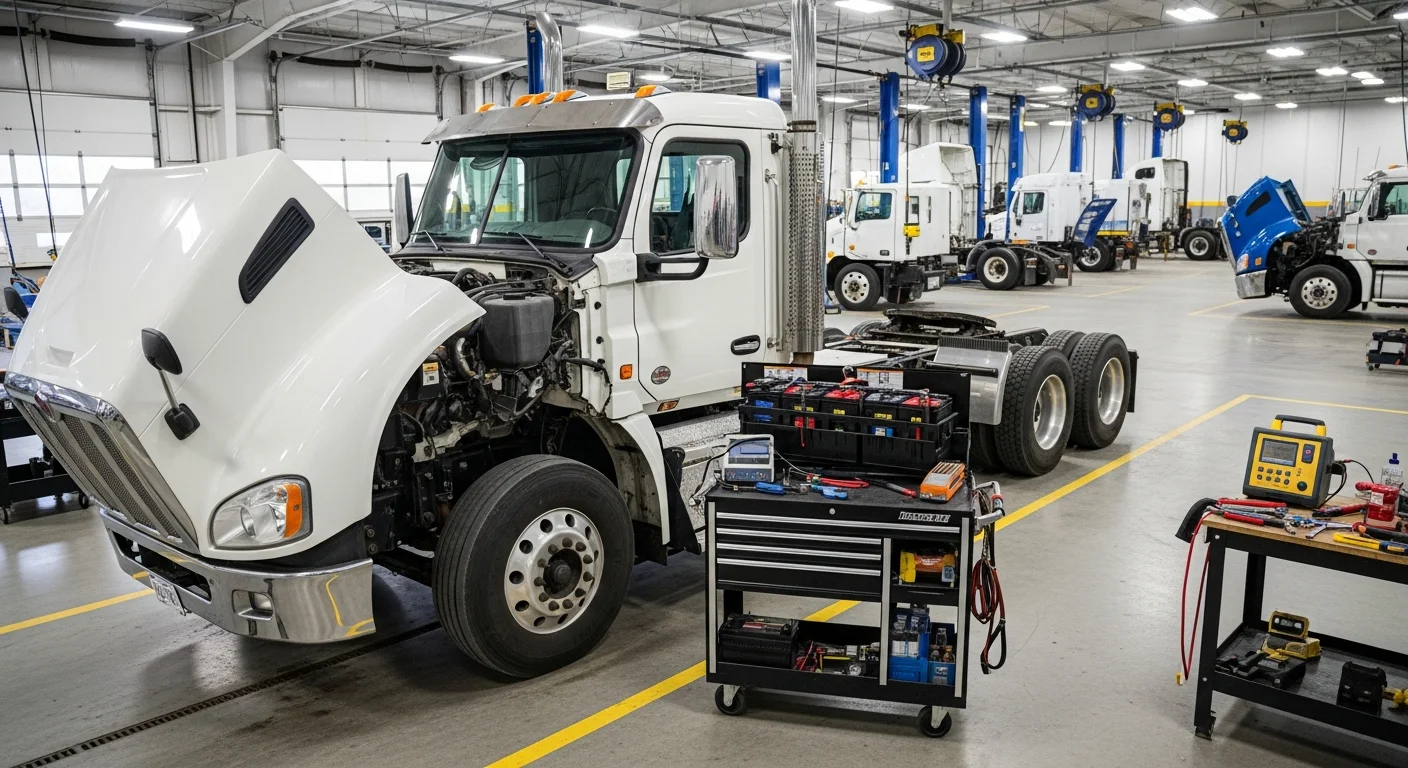
Heavy-duty truck battery maintenance is mostly about catching weak batteries, bad connections, and charging problems before the truck leaves you with a no-start. On a semi-truck, box truck, tow truck, or fleet unit, battery trouble is rarely just a battery issue by itself. It can also point to charging system problems, voltage drop, bad grounds, parasitic draw, or a truck that sits too long between runs.
For a driver or fleet manager, this matters because a battery failure usually shows up at the worst time: early morning dispatch, a fuel stop, a delivery dock, or after the truck sat over a weekend. That means missed loads, driver delay, jump-start calls, tow bills, and electrical complaints that keep coming back because the root cause never got checked.
A weak battery can look like a starter problem, an alternator problem, or a wiring problem until the truck is tested correctly.
Most battery failures give warning signs first. The problem is that drivers often work around them until the truck finally will not crank.
Common early signs are slow cranking, dim lights during startup, dash resets, low-voltage fault codes, starter clicking, or a truck that needs a jump after sitting. On newer trucks, low system voltage can also trigger sensor faults, communication issues, and random warning lights that make the problem look bigger than it started.
Battery age matters too. 3 to 5 years is a normal range for heavy-duty truck batteries under decent conditions, but heat shortens life fast. If the batteries are getting up in age and the truck has repeated hard starts, it is smarter to test them now than gamble on one more trip.
Drivers also need to know that battery complaints are often worse after idle time. A truck that starts every day may seem fine, but after a long weekend or a few cold mornings, the reserve capacity is gone. That is when weak batteries finally show themselves.
A good battery cannot do its job through bad cables. Corrosion, loose terminals, damaged battery box wiring, and poor grounds create resistance that steals cranking power.
This is where a lot of repeat breakdowns start. Somebody throws in a battery, the truck starts, and everyone thinks the problem is fixed. But if the cable ends are corroded, the hold-down is loose, or the frame and engine grounds are dirty, the new batteries still charge poorly and crank poorly.
That resistance creates voltage drop. In plain language, the power is there, but it cannot move cleanly from the batteries to the starter and back through the ground path. The result is slow crank, hot cables, starter strain, and charging complaints.
Terminal condition matters more than many operators think. Corrosion buildup restricts power flow and causes electrical resistance. Cleaning the terminals with a wire brush and protecting them afterward helps maintain reliable contact and reduces future buildup, as noted in this battery maintenance guide.
On heavy-duty trucks, do not stop at the battery posts. Check the cable ends, crossover cables, master disconnect connections, starter power cable, alternator output cable, and main grounds from battery to frame and frame to engine. A ground issue can mimic a bad starter all day long.
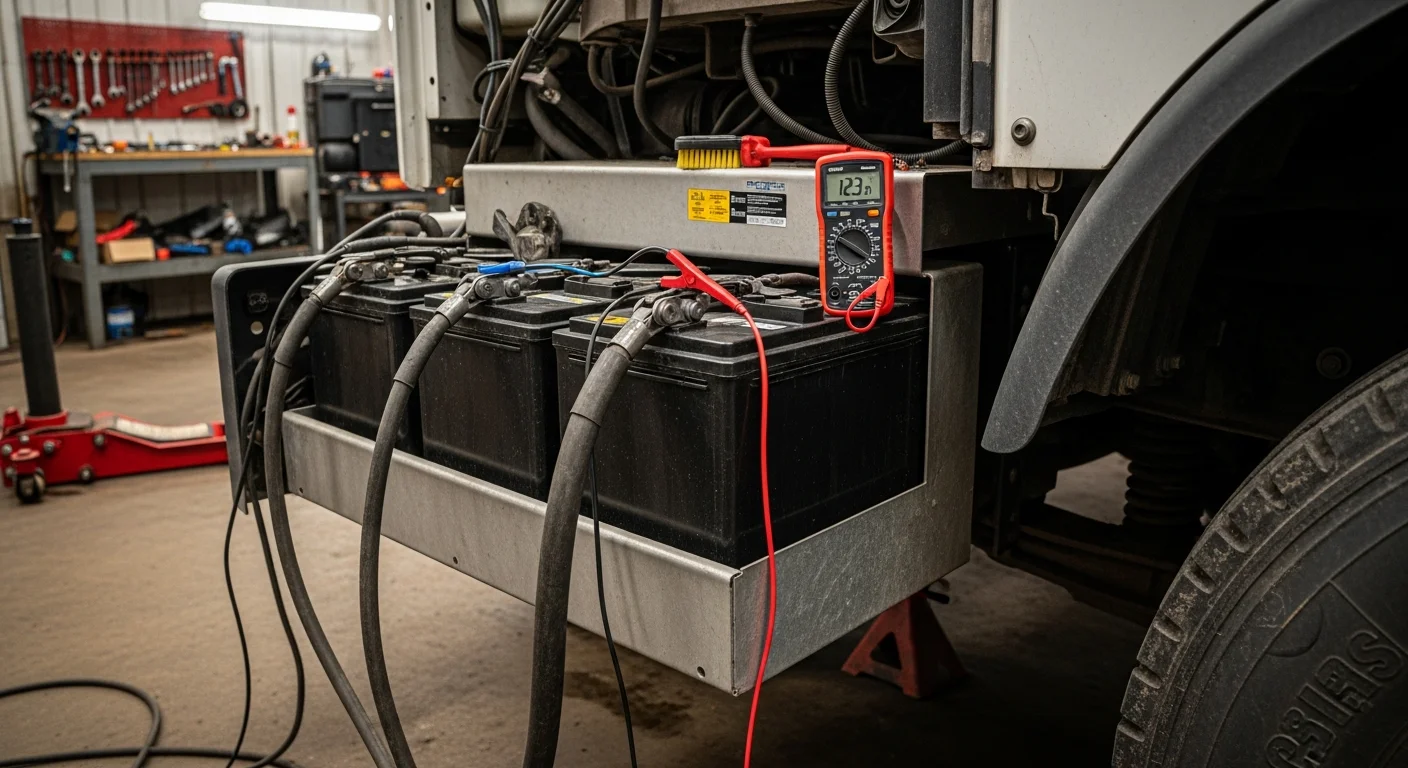
Start with the simple checks before replacing parts. A few minutes of inspection can tell you whether you are dealing with battery age, charging trouble, or a wiring problem.
Look at these items first:
After the visual check, test voltage with the engine off. A fully charged battery should read around 12.6 volts at rest. If the truck has a dual battery setup, compare both batteries. If one is significantly weaker than the other, the pair is already out of balance.
That leads to another mistake that costs people money: replacing only one battery in a matched set. On a dual battery setup, replace both at the same time. If one old battery stays in the system, it can drag the new one down and shorten the life of the replacement.
If the truck still has a hard-start issue after the batteries and terminals look decent, the next step is proper testing. That means load testing the batteries, checking alternator output, and doing voltage drop tests on the power and ground sides during cranking. Guessing gets expensive fast in electrical work.
Battery life depends heavily on how the truck is used. Short runs, long idle periods, seasonal downtime, and repeated jump-starts all take a toll.
A truck that runs daily highway miles usually treats batteries better than a unit that sits, makes short local runs, or has key-off electrical draw. Liftgates, inverters, bunk loads, work lights, and added accessories can also pull batteries down if the charging system and battery capacity were never matched to the load.
Charging habits matter more than most fleets realize. Good charging practices can extend battery life from roughly two years to four or more, and dead batteries remain a major cause of unexpected downtime on commercial equipment. That is one reason battery maintenance should be treated like part of PM service, not just an emergency repair.
Repeated deep discharge is especially hard on starting batteries. If a truck keeps needing a jump, do not just keep boosting it and sending it out. Every deep drain increases the odds of internal battery damage, sulfation, and a roadside no-start later.
It also puts more strain on the alternator. Drivers often assume the alternator will “charge it back up,” but recovering deeply discharged batteries is hard on the charging system and may not restore full battery health anyway.
Battery maintenance does not have to be complicated. It just has to be consistent.
A practical schedule is to do weekly visual checks for corrosion, loose connections, and hold-down problems; monthly voltage and electrolyte checks where applicable; quarterly load testing and ground inspection; and a yearly electrical system review to catch weak batteries before they strand the truck.
That kind of schedule makes sense for owner-operators and fleets because it cuts down on avoidable no-starts. It also gives you a chance to find charging issues, cable damage, and parasitic drain before the truck ends up dead at a shipper, truck stop, or yard.
If your operation has several trucks, write battery age and test results into the maintenance file. Once batteries get older, guessing based on “it started fine yesterday” is not much of a plan. A battery can pass one morning and fail the next cold start under load.
The real decision point is simple: do you want to replace batteries on your schedule, or deal with a no-start on the road? For most fleets, planned replacement and regular testing cost less than dispatch disruption, jump-start calls, and repeat electrical diagnostics after a breakdown.
If your truck has slow cranking, repeat jump-starts, low-voltage faults, or battery cables heating up, get the electrical side checked before it turns into a roadside no-start. Heavy Duty Truck Repair handles truck electrical repair in Homer Glen, IL, including battery, charging, and wiring diagnostics. Road service is available during business hours within 50 miles when the truck cannot make it in, and if roadside repair is not enough, Heavy Duty Truck Repair can help get the unit into the shop for proper testing and repair.
A quick visual check should be done weekly, especially on working trucks that see daily use. Voltage checks should be done monthly, and load testing makes sense quarterly or anytime the truck starts slowly, needs a jump, or shows low-voltage fault codes.
Yes, if the truck uses a dual battery setup, replacing both at the same time is usually the right move. One older battery can pull the new one down, shorten its life, and bring the same hard-start problem back.
Corrosion usually comes from moisture, acid vapor, loose connections, or poor charging conditions. If terminal corrosion keeps coming back, the truck should be checked for battery condition, charging voltage, cable fit, and ground problems.
Yes. A bad ground can cause slow cranking, clicking, hot cables, voltage drop, and low system voltage symptoms even when the batteries are still usable. That is why battery replacement alone does not always fix a no-start complaint.

Heavy Duty Truck Repair is currently going through an exciting period of reorganization and relocation to a new facility. As we prepare for this…
Tomas Labinskis
Aug 24, 2026
Your truck can need body repair even when the obvious crash damage looks minor, because hidden structural movement often shows up in the way…
Tomas Labinskis
Jul 17, 2026
A warning light on a heavy-duty truck is not just a reminder on the dash. It is the truck telling you a system has…
Tomas Labinskis
Jul 14, 2026